

If every AI session begins with a blank chat box and a vague instruction, the result will feel random. You may get a good caption one day, a generic content idea the next, and a reply that sounds nothing like your business on Friday. That is not an AI problem. It is a system problem.
For a founder-led business, the goal is not to collect clever prompts. The goal is to create a small marketing operating system that remembers the important context: who you help, what you offer, how you sound, what proof you can use and what action you want people to take. Once those inputs are stable, AI becomes much easier to direct and review.
Why random prompting produces random marketing
A one-off prompt usually asks AI to make decisions it should not be making: the customer, the offer, the brand voice, the channel, the level of proof and the call to action. Even a well-written prompt will drift if those ingredients are missing or change every time.
- The output is inconsistent because the input context is inconsistent.
- The copy sounds generic because it has not been given your real phrases, objections or examples.
- Review takes too long because every draft needs a fresh briefing.
- Good ideas disappear because they live in individual chats rather than a reusable library.
The five parts of a repeatable AI marketing system
1. Your business context
Create one short source document with your audience, offers, locations served, differentiators, objections, proof points and words you do or do not use. This is your reference sheet, not a 40-page brand book. Keep it specific enough that a new team member could understand what makes your business distinct.
2. A clear job for each workflow
Separate your recurring work into jobs such as blog outlining, LinkedIn posts, Instagram carousel copy, enquiry replies and weekly content planning. Each job needs a different format and a different finish line. A blog prompt should not try to become a Reel script, a sales reply and a newsletter at once.
3. Reusable prompt templates
Write prompts as templates with fields you can replace: [AUDIENCE], [OFFER], [TOPIC], [PROOF], [CTA] and [CHANNEL]. This keeps the thinking where it belongs, inside your marketing plan, while making execution much faster.
4. A human quality check
AI can draft. You still decide what is accurate, appropriate and genuinely helpful. Review for factual accuracy, local relevance, tone, claims, duplication and the next action. Never publish a draft simply because it is polished.
5. A simple storage and review habit
Keep the reference sheet, approved prompts and best-performing examples in one shared folder. At the end of each week, save what worked, improve the templates and delete the prompts you no longer use. Your system becomes smarter because your process becomes more intentional.
A practical starter workflow for this week
You do not need an automation stack to begin. Start with one weekly content workflow. For example, take one question your ideal client asks repeatedly and turn it into a source asset, then adapt it for the platforms you already use.
- Choose one client question: "How do I make my content more consistent without spending all day on it?"
- Add your business context and a clear audience to a blog-outline prompt.
- Approve the blog's main argument and three supporting points.
- Use a second template to turn the approved argument into a LinkedIn post, carousel outline, short video script and two conversation-led social posts.
- Review every version against your voice and replace broad claims with real examples or useful next steps.
What to automate and what to keep human
Use AI for the repeatable first pass: sorting ideas, creating outlines, translating an approved point into channel-specific formats and suggesting ways to make a draft clearer. Keep human judgment for the moments where trust is at stake: customer promises, pricing, sensitive replies, real client stories and decisions about what your brand should stand for.
Your first system does not have to be perfect
A repeatable system is allowed to be small. One context document, three templates and a review checklist are enough to make your next week of marketing easier. The benefit is not that AI suddenly does everything. The benefit is that you no longer have to re-explain your business from the beginning every time you need a draft.
Image credits and reuse notes
Both embedded photos were selected as real photographs, not AI-generated images. They are supplied under open licenses suitable for commercial reuse.
- Desk-laptop-notebook-table (23697249344).jpg – www.Pixel.la Free Stock Photos – CC0 1.0. Source: https://commons.wikimedia.org/wiki/File:Desk-laptop-notebook-table_(23697249344).jpg
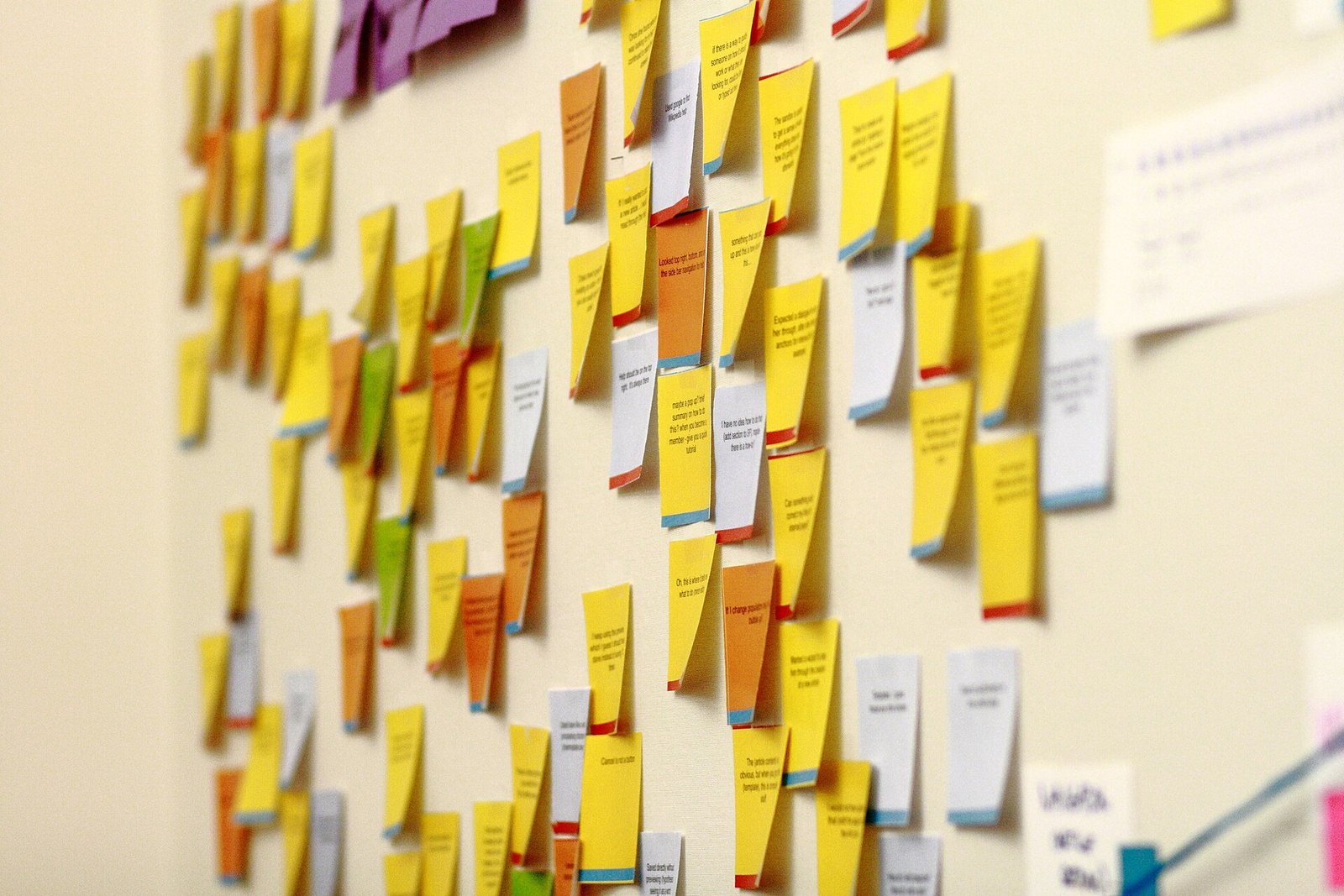
- Sticky notes on the wall of the Wikimedia Foundation office, 2010-10-26.jpg – Wikimedia Foundation – CC BY 3.0 / GFDL. Source: https://commons.wikimedia.org/wiki/File:Sticky_notes_on_the_wall_of_the_Wikimedia_Foundation_office,_2010-10-26.jpg. Attribution is required when reused.